
Dear Community,
What happened on Wednesday is not just another court decision.
With the stroke of a pen, the Supreme Court made it harder to challenge unfair voting maps. And we need to be honest about what that means.
It means communities, especially Black communities, can be divided, diluted, and pushed out of fair representation with fewer tools to fight back. It means the ability to choose our representatives is weakened. And in too many cases, our representatives will be chosen for us.
That is not democracy. That is the erosion of it.
This decision is a direct hit to the heart of the Voting Rights Act, one of the most important protections this country has ever had. The Voting Rights Act was not given freely. It was fought for, organized for, and won through sacrifice. Just 60 years later, we are watching those protections be chipped away in real time.
And we did not arrive at this moment blindly.
For years, we have witnessed the steady erosion of voting rights protections in this country.
Piece by piece.
Decision by decision.
Until we arrive here.
And the impact will not be evenly felt.
It will fall hardest on Black communities.
On brown communities.
On communities navigating poverty, housing instability, and the impacts of the criminal legal system.
The same communities we work with every single day.
This is not just about maps.
This is about power.
Who has it. Who gets to shape it.
And who is left fighting just to be heard.
Because at the same time protections are being weakened, we are also seeing efforts to make voting more complicated through documentation requirements, paperwork barriers, and policies that create confusion and fear.
From proof of citizenship proposals,
to barriers in jail voting,
to prison gerrymandering that counts people in the wrong place,
It is all connected.
It is all shaping who is included in our democracy and who is not.
And the consequences will not stop with one community. When representation is distorted, it ripples across entire states. It impacts resources, policy decisions, and whose voices are taken seriously.
So no, we cannot treat this like normal.
This is a moment that demands more.
More organizing.
Stronger civic education.
A deeper commitment to reaching people who have been left out for far too long.
Because if the protections are weaker, our organizing has to be stronger.
Voting Access For All Coalition is clear about our role in this moment.
This is why we organize in jails.
This is why we bring voter education into shelters and communities navigating housing instability.
This is why we fight policies that create barriers instead of access.
And this is why we are pushing to end prison gerrymandering.
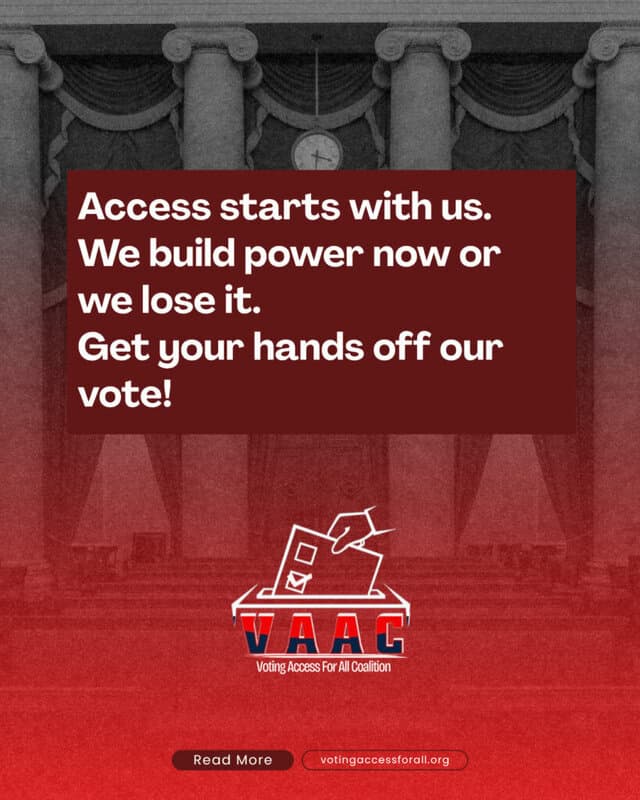
Because building civic power starts with access.
And access does not happen by accident.
It is built.
Or it is blocked.
And right now, we are watching it be blocked.
Here in Michigan, we have fought hard to expand access and protect voters, but this moment calls for more. We must defend what we have built and continue pushing forward, including passing a Michigan Voting Rights Act that strengthens protections and ensures every voter has a fair chance to be heard.
Let me be clear about what comes next.
We are not disengaging.
We are not waiting.
And we are not accepting a future where our communities are pushed out of representation.
We are organizing.
We are educating.
And we are building power where it has been denied for far too long.
Because we understand something fundamental
We deserve to choose our representatives
Not have them chosen for us
And we will keep building until that is a reality
In solidarity,
Angela Davenport
Executive Director
Voting Access For All Coalition
The post A Letter from Our Executive Director on the Supreme Court’s Decision in Louisiana v. Callais: This Is Not Normal appeared first on Voting Access For All.